
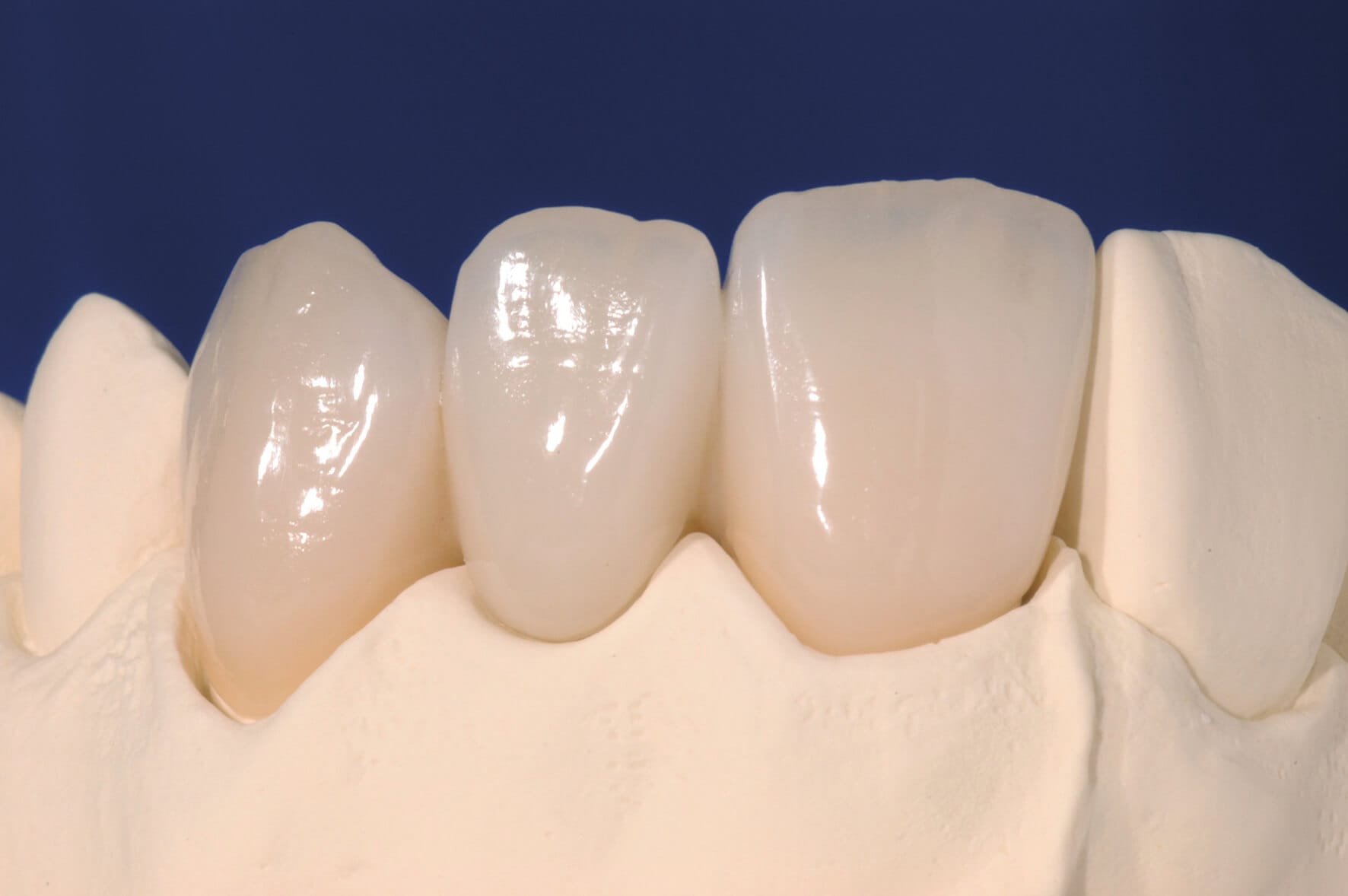
Zirconia Bridges
A dental bridge is a fixed prosthetic device used to replace one or more missing teeth by anchoring artificial teeth (pontics) to adjacent natural teeth or implants. The bridge 'bridges' the gap left by missing teeth, restoring the appearance and function of the smile. At Rivfor Dental Lab, we specialize in zirconia bridges, known for their exceptional strength, durability, and natural-looking aesthetics.
Get in touchTypes of Zirconia Bridges
Traditional Bridge
The most common type, a traditional bridge consists of a pontic (false tooth) held in place by dental crowns cemented onto the neighboring teeth (abutment teeth) on either side of the gap.
Cantilever Bridge
Similar to a traditional bridge but uses only one adjacent tooth for support rather than teeth on both sides of the missing tooth.
Maryland Bridge
Also known as a resin-bonded bridge, this type uses a metal or porcelain framework attached to the back of adjacent teeth, rather than crowns, to hold the pontic in place.
Digital Bridge Workflow
Zirconia bridges require precise design to ensure passive fit across multiple abutments — and that is where our fully digital workflow makes a difference. When you submit a bridge case, our CAD technicians design each pontic and retainer individually, verifying contact points, connector dimensions, and occlusal anatomy in the digital model before any milling begins.
We mill every bridge from a single zirconia disc, producing a monolithic restoration with no soldered joints or bonded sections. This one-piece construction gives zirconia bridges their exceptional strength and fracture resistance. After milling, each bridge is finished with custom staining and glazing to achieve natural shade transitions across the entire span.
For cases submitted as digital scans, we recommend capturing the full arch including all abutment teeth, adjacent dentition, and the opposing arch. Bite registration scans are critical for bridge cases to ensure accurate occlusal design.
Material Selection for Bridges
Bridge restorations place higher demands on material strength than single crowns, particularly at the connectors between pontics and retainers. We recommend the following materials based on clinical situation:
HT Multilayer Zirconia (1,250 MPa) — Our standard recommendation for bridges of any span length. The multilayer shade gradient produces a natural appearance across the full bridge, while the high flexural strength ensures reliable performance even in posterior load-bearing areas. Supports single units through full-arch restorations.
High Translucent Zirconia (1,250 MPa) — Ideal for posterior bridges where shade matching to adjacent natural teeth is less critical. Available in white and pre-shaded blanks.
Super Translucent Multilayer (850 MPa) — Suitable for anterior bridges up to 3 units with one pontic. Offers maximum esthetics but has lower strength, so it is not recommended for long-span posterior bridges.
We design connectors with a minimum cross-sectional area of 9 mm² for posterior bridges and 6 mm² for anterior bridges to ensure structural integrity while maintaining natural gingival embrasure form.
Implant-Supported Bridges
In addition to tooth-supported bridges, we fabricate implant-supported zirconia bridges in both screw-retained and cement-retained configurations. For implant cases, we work with titanium bonding bases (Ti-Bases) compatible with major implant systems.
Submitting an implant bridge case digitally is straightforward: scan with the appropriate scan body seated on each implant, capture the full arch, and submit the STL files along with your prescription specifying the implant system and platform diameter. Our technicians will design the bridge framework with proper screw access channels and emergence profiles.
Span Limitations and Clinical Considerations
Zirconia's high flexural strength allows us to fabricate bridges ranging from 3-unit spans to full-arch restorations. However, the appropriate material grade depends on the span length and location. For bridges exceeding 4 units in the posterior region, we strongly recommend HT or HT Multilayer zirconia at 1,250 MPa to ensure long-term reliability.
Proper abutment preparation is essential for bridge longevity. We recommend parallel axial walls with 4–6 degrees of total taper per abutment, a minimum occlusal reduction of 1.5 mm, and a well-defined chamfer or shoulder margin of at least 0.5 mm depth. Consistent draw between abutments ensures passive fit of the final restoration.
Key Features
Tooth Replacement
Bridges fill the gap left by missing teeth, preventing the remaining teeth from shifting out of position.
Tooth Stability
By using abutment teeth, bridges provide a stable and secure solution for replacing missing teeth.
Improved Chewing
Bridges restore the ability to properly chew food and speak clearly, which can be affected by missing teeth.
Tooth Aesthetics
Bridges can be customized to match the color, shape, and size of natural teeth.
Explore Our Other Zirconia Services
Contact our Hialeah dental lab for a free consultation on any zirconia restoration.