Zirconia Implants
Dental implants are a popular and effective tooth replacement option. They consist of a small titanium or zirconia post that's surgically placed into the jawbone, serving as an artificial tooth root. Over time, the implant integrates with the bone in a process called osseointegration, providing a strong and stable foundation for a replacement tooth or bridge. Dental implants are designed to look, feel, and function like natural teeth, making them a long-term solution for missing teeth.
Get in touchTypes of Zirconia Dental Implants
Screw Retained
In this type, the restoration (crown or bridge) is attached to the implant with a screw. This allows for easy removal and adjustment by the dentist, making it ideal for maintenance and future modifications.
Cement Retained
Here, the restoration is attached to the implant using dental cement. This method provides a clean, aesthetically pleasing result as there are no visible screw access holes.
Implant Supported Bridge
This is a bridge that's anchored to dental implants rather than natural teeth. It's used when multiple adjacent teeth are missing and provides a stable, long-term solution without relying on natural teeth for support.
Digital Implant Restoration Workflow
Our implant restoration workflow is designed to be seamless for practices using digital scanners. To submit an implant crown or bridge case, simply scan the area with the manufacturer's scan body seated on the implant. We accept STL files from CEREC, 3Shape, iTero, Carestream, Medit, Planmeca, and 3M systems.
Your prescription should include the implant system and platform size, the type of restoration desired (screw-retained or cement-retained), shade selection, and any specific design preferences for emergence profile or screw access positioning.
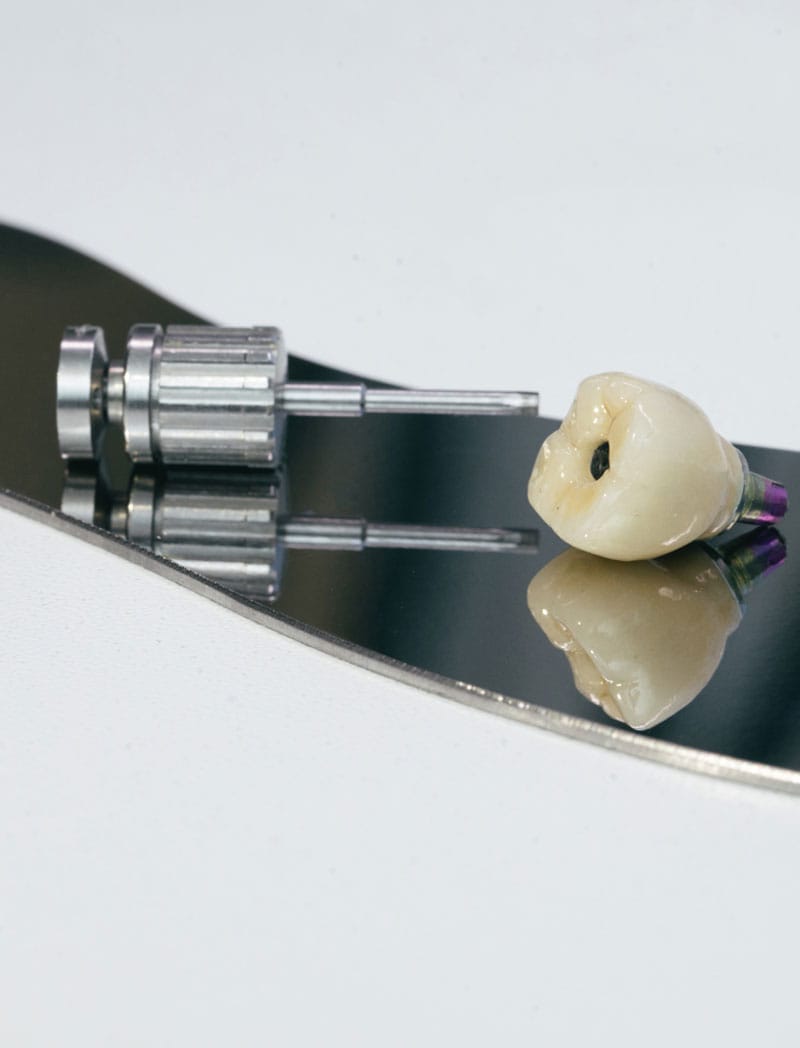
Once we receive your files, our CAD team designs the restoration over a titanium bonding base (Ti-Base) that connects directly to the implant. The zirconia crown or bridge is then milled, stained, glazed, and bonded to the Ti-Base in our lab — delivered ready to seat.
For practices that prefer analog impressions, we also accept open-tray or closed-tray implant impressions with the appropriate impression coping for your implant system.
Screw-Retained vs Cement-Retained: Considerations for Your Practice
Choosing between screw-retained and cement-retained implant crowns depends on the clinical situation, and we fabricate both configurations with equal precision.
Screw-retained restorations offer the advantage of retrievability — the crown can be removed for maintenance, soft tissue evaluation, or abutment access without damaging the restoration. We design screw access channels to exit through the occlusal surface or cingulum area whenever implant positioning allows. This configuration eliminates cement-related complications, making it a popular choice for both anterior and posterior cases.
Cement-retained restorations allow more flexibility in compensating for angled implant placement, since the custom abutment can be designed with an ideal emergence angle independent of the implant axis. They also eliminate the screw access hole, which some clinicians prefer for anterior esthetic cases. We recommend using a retrievable cement to preserve the option of future crown removal.
| Configuration | Retrievability | Cement complications | Angled implant compensation | Screw access channel | Anterior esthetics | Typical indication |
|---|---|---|---|---|---|---|
| Screw-retained | Crown removes without damaging the restoration | Eliminated — no cement used | Constrained by the implant axis | Exits the occlusal surface or cingulum area | Access hole may be visible | Cases needing maintenance access, anterior and posterior |
| Cement-retained | Limited — use a retrievable cement to preserve the option | Possible, including excess subgingival cement | Flexible — custom abutment sets the emergence angle | None | No access hole | Angled placement and anterior esthetic cases |
If you are unsure which configuration is best for a particular case, contact our team — we are happy to discuss the options and recommend an approach based on the implant position and your treatment goals.
Implant System Compatibility
We work with restorative components from all major implant systems. Whether your practice places Straumann, Nobel Biocare, Zimmer Biomet, BioHorizons, Hiossen, Osstem, Megagen, Neodent, or another system, we have the digital libraries and Ti-Base inventory to fabricate your restoration accurately.
When submitting a case, please specify the exact implant system and platform diameter on your prescription. This ensures we select the correct Ti-Base connection and design the restoration with the proper engagement geometry.
Materials for Implant Restorations
For single implant crowns, all three of our zirconia grades are appropriate depending on the tooth position. Posterior implant crowns benefit from HT or HT Multilayer zirconia at 1,250 MPa, while anterior implant crowns in the esthetic zone may warrant Super Translucent Multilayer at 850 MPa for optimal light transmission.
For implant-supported bridges and full-arch restorations, we exclusively recommend HT or HT Multilayer zirconia to ensure the connector cross-sections and pontic spans can withstand occlusal forces reliably over time.
Key Features
Implant Body
This is the part that's surgically inserted into the jawbone. It's typically made of titanium or a titanium alloy, known for its biocompatibility and ability to integrate with the bone (osseointegration).
Abutment
This is the connector piece that sits on top of the implant body and above the gum line. It serves as the foundation for the restoration.
Restoration
This is the visible part of the implant—the custom-made crown, bridge, or denture that's placed on top of the abutment.
Explore Our Other Zirconia Services
Contact our Hialeah dental lab for a free consultation on any zirconia restoration.