Zirconia (Zirconium Dioxide) Crowns
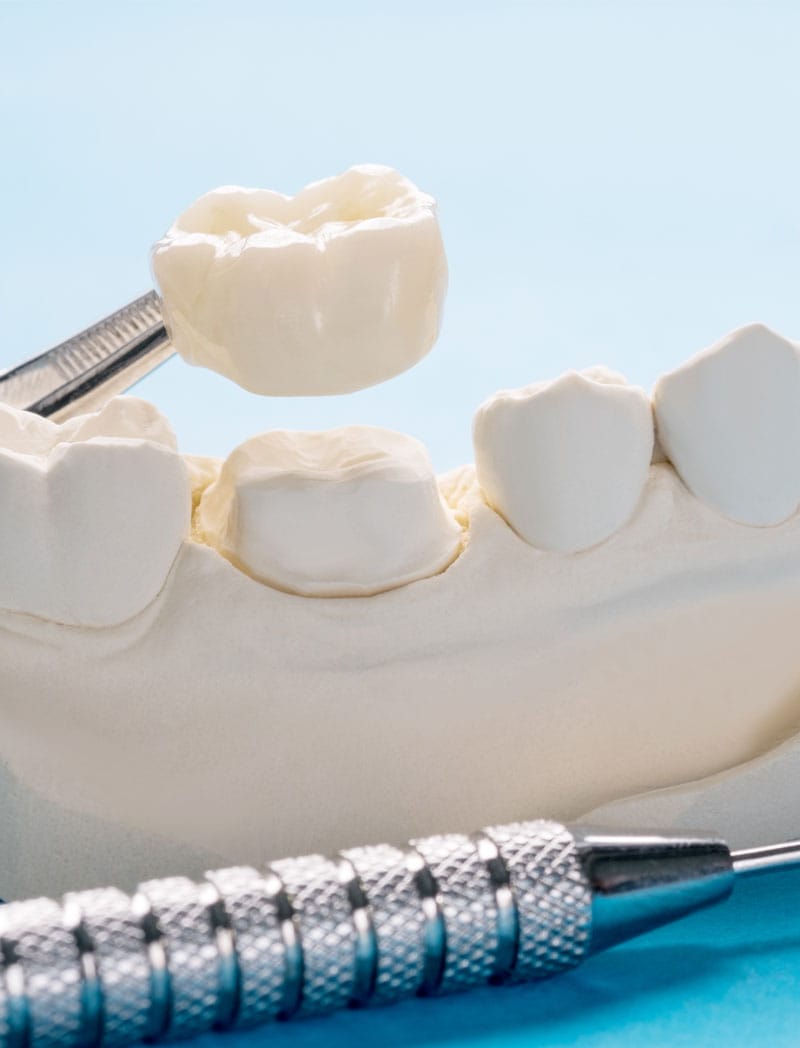
A dental crown, also known as a tooth cap, is a prosthetic restoration that covers and encases a damaged or weakened tooth. It's designed to restore the tooth's shape, size, strength, and appearance while protecting it from further damage. Crowns can be made from various materials, but at Rivfor Dental Lab, we primarily use zirconia — zirconium dioxide (ZrO₂), a metal-free ceramic — for its superior strength, durability, and natural appearance.
Contact UsZirconia, Zirconium Oxide, or Zirconium Dioxide — What's the Difference?
There is no difference — they are three names for the same material. Zirconia is the dental ceramic zirconium dioxide (ZrO₂), which also appears in the literature as zirconium oxide. Dentists and labs often shorten it further to a "Zr crown." If you have been quoted a zirconium dioxide crown by one office and a zirconia crown by another, you are comparing the same restoration.
The name does cause one common misconception: zirconium is a metal, so a "zirconium crown" sounds like a metal crown. It isn't. Crowns are milled from zirconium's oxide — a white, biocompatible ceramic — so a zirconium oxide crown is 100% metal-free, with no alloy substructure and no dark line at the gumline as tissue recedes.
Every crown we describe on this page — full-contour, multilayer, and super-translucent — is this same ZrO₂ ceramic, milled from different grades of zirconia disc. Wondering what these crowns cost? See our zirconia dental crown price guide for typical lab fees and patient prices.
Our CAD/CAM Crown Workflow
Every zirconia crown we produce at Rivfor Dental Lab follows a fully digital CAD/CAM workflow designed for precision and speed. The process starts when we receive your case — either as an intraoral scan from systems like CEREC, 3Shape, iTero, Medit, or Planmeca, or as a traditional impression that we digitize in-house using our benchtop scanner.
Our technicians design the crown digitally, optimizing occlusal anatomy, contact points, and margin fit before milling begins. Each restoration is milled from a solid zirconia disc, then finished with custom staining and glazing to match the prescribed VITA shade. The result is a monolithic crown with no porcelain overlay, eliminating the risk of chipping or delamination that can occur with layered restorations.
For practices in Miami-Dade and Broward, we offer free local pickup and delivery — your case can go from scan to seated crown in as little as 48 hours.
Zirconia Materials for Crowns
We mill exclusively with ArgenZ zirconia from The Argen Corporation — FDA 510(k) cleared, isostatically pressed, and made in the USA. We stock three grades, each suited for different clinical situations:
ArgenZ HT+ (High Translucent) — 45% translucency with 1,250 MPa flexural strength. Ideal for posterior single crowns where strength is the priority. Argen rates it for single units through full roundhouse restorations, and states it offers 4–5% more translucency and greater strength than other HT zirconia. Available in white and pre-shaded blanks for efficient staining.
ArgenZ HT+ Multilayer — 45% translucency at 1,250 MPa, with a built-in shade gradient from cervical to incisal that mimics natural dentin-to-enamel transitions. Available in 16 VITA Classical shades, 3 Bleach, and 5 Light shades — the Light shades are formulated for implant-retained full-arch restorations. This is our most versatile material, suitable for both anterior and posterior cases.
ArgenZ ST Multilayer (Super Translucent) — 50% translucency at 850 MPa. Designed for highly esthetic anterior crowns where light transmission matters most. Its translucency approaches lithium disilicate while maintaining significantly greater strength. Argen rates it for single crowns through 3-unit bridges with one pontic. Available in 16 VITA Classical and 3 Bleach shades.
Not sure which material is right for your case? Contact us and our technicians will help you choose based on the tooth position, shade requirements, and occlusal demands.
Zirconia vs PFM vs Lithium Disilicate
Dentists often ask how zirconia crowns compare to PFM and lithium disilicate (e.g., IPS e.max). Here is a practical comparison:
| Material | Flexural strength | Translucency | Metal-free | Chipping risk | Best indication |
|---|---|---|---|---|---|
| Monolithic zirconia (ArgenZ HT+ / ST) | 850–1,250 MPa | Good — high with Super Translucent Multilayer | Yes | Minimal — milled from a single block, no porcelain overlay | Posterior crowns, bruxism cases, full-contour restorations |
| Lithium disilicate (IPS e.max) | 530 MPa (e.max CAD) / 470 MPa (e.max Press) | High | Yes | Low | Anterior crowns where maximum translucency is required |
| PFM (porcelain-fused-to-metal) | Variable — depends on the alloy | Low — opaque metal core | No — metal substructure | Higher — porcelain can chip or delaminate | Legacy cases; risk of dark gingival line with non-precious alloys |
Zirconia offers flexural strength of 850–1,250 MPa. Ivoclar publishes 530 MPa for IPS e.max CAD and 470 MPa for IPS e.max Press (both biaxial), and PFM strength varies with the alloy. Zirconia is fully metal-free, biocompatible, and produces no dark gingival lines — a common concern with non-precious PFM restorations.
Modern multilayer zirconia has closed the esthetics gap with lithium disilicate significantly. For posterior restorations, zirconia's superior strength makes it the preferred choice. For anterior cases where maximum translucency is needed, our Super Translucent Multilayer zirconia delivers natural-looking results without sacrificing durability.
All of our zirconia crowns are monolithic, meaning they are milled from a single block with no porcelain overlay. This eliminates the chipping and delamination risk associated with traditional PFM and porcelain-layered zirconia restorations.
Sources
Preparation Guidelines
For optimal results with our zirconia crowns, we recommend the following preparation guidelines:
Provide a minimum occlusal reduction of 1.0–1.5 mm and axial reduction of 0.8–1.0 mm. Use a chamfer or rounded shoulder margin with a minimum depth of 0.5 mm. Avoid sharp angles and ensure all line angles are rounded, as zirconia restorations perform best on smooth, well-defined preparations.
We accept both digital scans (STL files) and traditional polyvinyl siloxane impressions. For digital submissions, ensure the scan captures the full preparation margin, adjacent teeth, and opposing arch. For analog impressions, we recommend a two-cord retraction technique for clear margin capture.
Key Features
Protection
Crowns protect weakened teeth, such as those with large fillings or after root canal treatment, from further damage.
Aesthetics
Crowns can be color-matched and shaped to blend with surrounding teeth.
Functionality
They restore the ability to bite and chew properly.
Durability
High-quality materials like zirconia make crowns highly durable and long-lasting.
Frequently Asked Questions
Zirconia dental crowns are extremely durable and can last 15 years or longer with proper oral care. Their high flexural strength (up to 1250 MPa) makes them one of the longest-lasting crown materials available.
Yes. Zirconia is the ceramic zirconium dioxide (ZrO₂), also written as zirconium oxide — three names for the same material. Dentists and labs sometimes shorthand it as a Zr crown. Whatever the label, it is the same metal-free restoration.
Yes. Although zirconium itself is a metal, crowns are milled from its oxide — a white, biocompatible ceramic. There is no alloy substructure, so there is no dark line at the gum and no risk of metal allergy.
There are two different numbers: the lab fee a dentist pays (published US figures run roughly $89–$220 per unit) and the price a patient pays chairside, which also covers preparation, chair time, and overhead. Our zirconia dental crown price guide on the blog breaks down both, and dentists can contact us for our current price list.
While same-day crowns are typically done chairside by the dentist, Rivfor Dental Lab in Hialeah, FL offers turnaround times as fast as 48 hours using CAD/CAM custom milling. We also provide free local pickup and delivery throughout Miami-Dade and Broward.
Rivfor Dental Lab serves dental practices across South Florida, including Hialeah, Miami, Doral, Miami Lakes, Miami Beach, Coral Gables, Kendall, Homestead, Miami Gardens, Pembroke Pines, Hollywood, and Fort Lauderdale. We offer free pickup and delivery within our local service area.
Explore Our Other Zirconia Services
Contact our Hialeah dental lab for a free consultation on any zirconia restoration.